Before 1896, an American recipe was a letter from one experienced cook to another. It asked for butter the size of an egg, a teacup of milk, flour to make a soft dough, a quick oven. None of this was imprecision, exactly — it was shorthand among people who shared a training. But it slammed the door on everyone who didn’t. A recipe that says enough flour is legible only to a cook who already knows what enough looks like, which is to say it teaches nothing; it merely reminds.
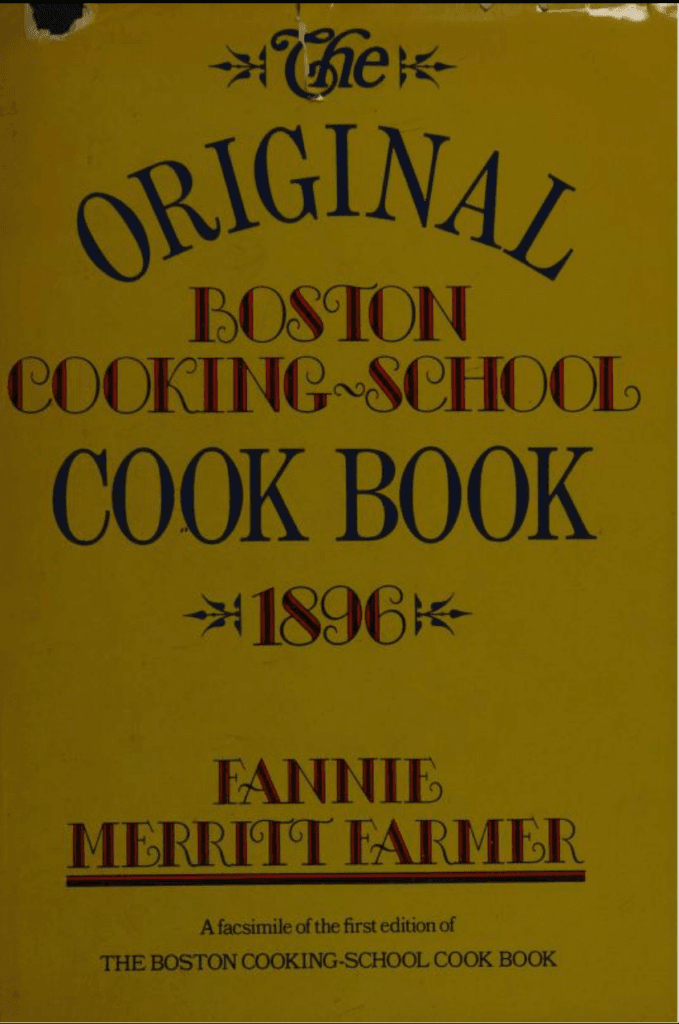
Fannie Merritt Farmer’s Boston Cooking-School Cook Book, published that year, is remembered as a bestseller and was actually a reform. Farmer — who had come to cooking after a paralytic illness derailed her schooling, and who ran the Boston Cooking School with a scientist’s temperament — decided that a recipe should be an instrument anyone could read. Her tool was almost embarrassingly humble: the level measure.
A cupful is measured level. A tablespoonful is measured level. A teaspoonful is measured level.
Three sentences, flat as the knife drawn across the cup’s rim, and a whole oral tradition became a written language. The rounded spoonful, the heaping cup, the pinch and the lump — all the old approximations that varied with the cook’s hand and mood — were replaced by units that meant the same thing in every kitchen in the country. It is standardization, which sounds cold, and was care: what Farmer leveled was not cooking but the barrier to entry. The knowledge that had lived in apprenticeship — at a mother’s or an employer’s elbow — could now travel by mail to any literate stranger and work the first time.
A Working Specimen
Here is the grammar in action — biscuits, in the period manner, adapted from the 1896 edition:
Baking Powder Biscuit
- 2 cups flour
- 4 teaspoons baking powder
- 1 teaspoon salt
- 2 tablespoons butter
- ¾ cup milk, about
- Mix the dry ingredients and sift twice.
- Work in the butter with the tips of the fingers.
- Add the milk gradually, mixing to a soft dough.
- Toss on a floured board, pat, and roll lightly to three-fourths inch thickness.
- Shape with a biscuit cutter and bake in a hot oven twelve to fifteen minutes.
Read it slowly and notice how much trust the form extends in both directions. The measures are exact where exactness can be given — cups, teaspoons, fractions of an inch — and honest where it can’t: about, soft, lightly, hot. Farmer never pretended cooking was chemistry all the way down. The level cup handles what a beginner cannot yet judge, precisely so the beginner’s attention is freed for what no measure can convey — the feel of a soft dough, the discipline of a light hand. The recipe’s precision is not a cage but a ladder: you climb it until your hands know the way, and then, like every cook before 1896, you stop needing the rungs.
That may be the quiet lesson of the level cup for any craft. Good notation does not replace judgment; it hosts the beginner until judgment arrives. Farmer’s book sold in the millions because it made a previously guarded competence common property — nourishment, in the fullest sense of a word she would have liked: not just the biscuit, but the capacity to make it, handed level across the rim to whoever comes next.
The 1896 Boston Cooking-School Cook Book is in the public domain and free to read at Project Gutenberg.