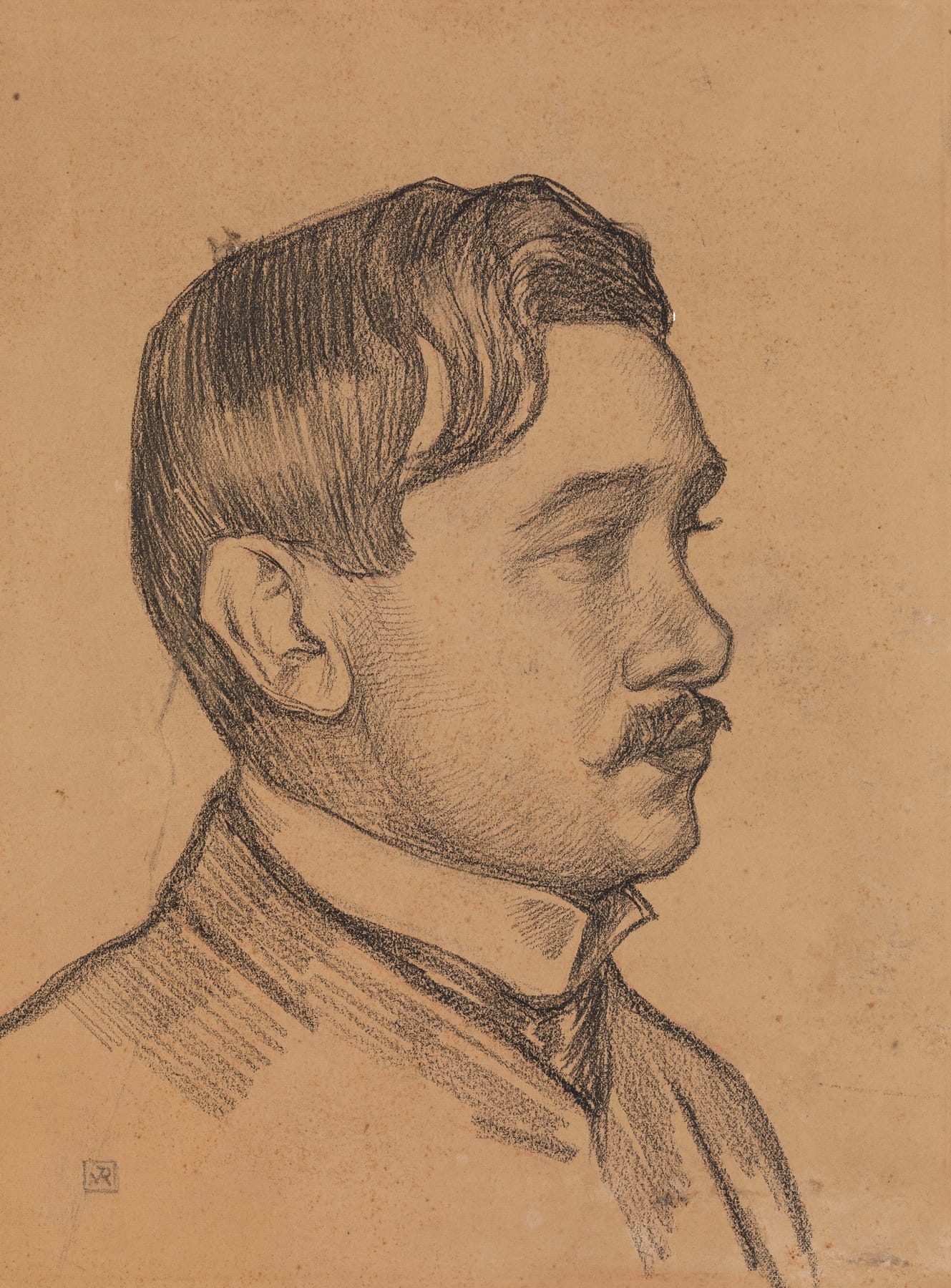
In 1896, the Belgian playwright Maurice Maeterlinck — later a Nobel laureate, then still best known for plays in which almost nothing happens and everything is felt — opened a book of essays with a meditation on the thing his theater was made of. The Treasure of the Humble begins with “Silence,” and it begins with a demotion: of speech.
It is idle to think that, by means of words, any real communication can ever pass from one man to another.
This sounds like despair and is meant as its opposite. Words, Maeterlinck argues, are fine for the traffic of ordinary business — for asking directions, closing accounts, filling the hour. What they cannot carry is the freight we most want carried. The moment two people approach anything that matters to them, he observes, they fall quiet, or wish they could; and the quality of that quiet tells them more about each other than the preceding hour of talk. Silence is not the failure of the conversation. It is the conversation, arriving.
Maeterlinck is careful to distinguish two silences. There is a passive kind — the silence of sleep, of absence, of the room after everyone has left — which is merely the sound of nothing happening. And there is an active kind, the silence two people consent to hold together, which he treats almost as a substance: something with weight, temperature, and consequence. It is the second kind that interests him, because it is the second kind we fear. We will do nearly anything, he notes, to avoid sharing real silence with someone we do not love — we invent small talk precisely as insulation — because to be silent together is to be, briefly, without defenses.
Souls are weighed in silence, as gold and silver are weighed in pure water, and the words that we pronounce have no meaning except through the silence in which they are bathed.
The image repays a slow read. Water does not add anything to the gold; it removes distortion, lets the true weight register. So with the pauses around our sentences: they are not empty margin but the medium in which whatever we said is finally assayed. A compliment followed by the wrong silence curdles. A plain sentence surrounded by the right one can hold a whole friendship.
It is easy to hear all this as a period piece — Symbolist mood-lighting from a vanished Europe. Harder, and more useful, is to hear it as a description of practice. Attention, whatever else it is, requires a surface quiet enough to register what lands on it; a mind narrating constantly is water too agitated for weighing anything. Maeterlinck’s essay suggests that such quiet is not a private achievement but a social one — that the deepest thing we can offer another person is not our best sentence but our willingness to stop producing sentences and remain present anyway.
Which may be why the essay ends up feeling less like philosophy than like instruction. Sit with someone. Let the talk run out. Do not reach for the next remark as if silence were a stalled engine. Wait, and notice what the quiet begins to weigh. The treasure of the humble, Maeterlinck thought, is exactly this: an inheritance available to anyone, requiring no eloquence at all — only the nerve to stop speaking and the attention to hear what speech had been covering.
“Silence” appears in The Treasure of the Humble (1896), translated by Alfred Sutro; the full text is in the public domain and free to read at Project Gutenberg.