“Walking” began as a talk. Thoreau read it first at the Concord Lyceum in the spring of 1851, then kept it in circulation for a decade — revising, re-delivering, splitting it in two and joining it back together — before preparing it for print in the last winter of his life. The Atlantic published it in June 1862, a month after his death. What survives reads less like an essay than a practice written down: instructions, half teasing and wholly sincere, for an activity most of us assume we already know how to do.
His first move is to take the word itself out walking:
I have met with but one or two persons in the course of my life who understood the art of Walking, that is, of taking walks — who had a genius, so to speak, for sauntering, which word is beautifully derived “from idle people who roved about the country, in the Middle Ages, and asked charity, under pretense of going à la Sainte Terre,” to the Holy Land, till the children exclaimed, “There goes a Sainte-Terrer,” a Saunterer, a Holy-Lander.
The etymology is shaky and the joke is plain, but the joke is doing serious work. A saunterer, on this derivation, is a pilgrim without a destination — someone for whom the holy land is not at the road’s end but underfoot the entire way. Thoreau is careful to set this apart from what ordinarily passes for a walk. Exercise, errand, the doctor’s constitutional: these keep the mind exactly where it was, only in motion. Sauntering asks for something rarer, and he is only half joking when he warns that “it requires a direct dispensation from Heaven to become a walker.”
The dispensation, it turns out, keeps a schedule:
I think that I cannot preserve my health and spirits, unless I spend four hours a day at least — and it is commonly more than that — sauntering through the woods and over the hills and fields, absolutely free from all worldly engagements.
Four hours is an outrageous prescription, and he knows it. But the number matters less than the claim underneath it: that attention is metabolic. It is not a faculty you own but a condition you maintain, and it must be fed daily — on weather, on ground, on the ten thousand small events of a landscape — or it thins. Read this way, the essay is not really about legs at all. Walking is simply the oldest reliable technology for putting a mind back in a body.
Returning to Our Senses
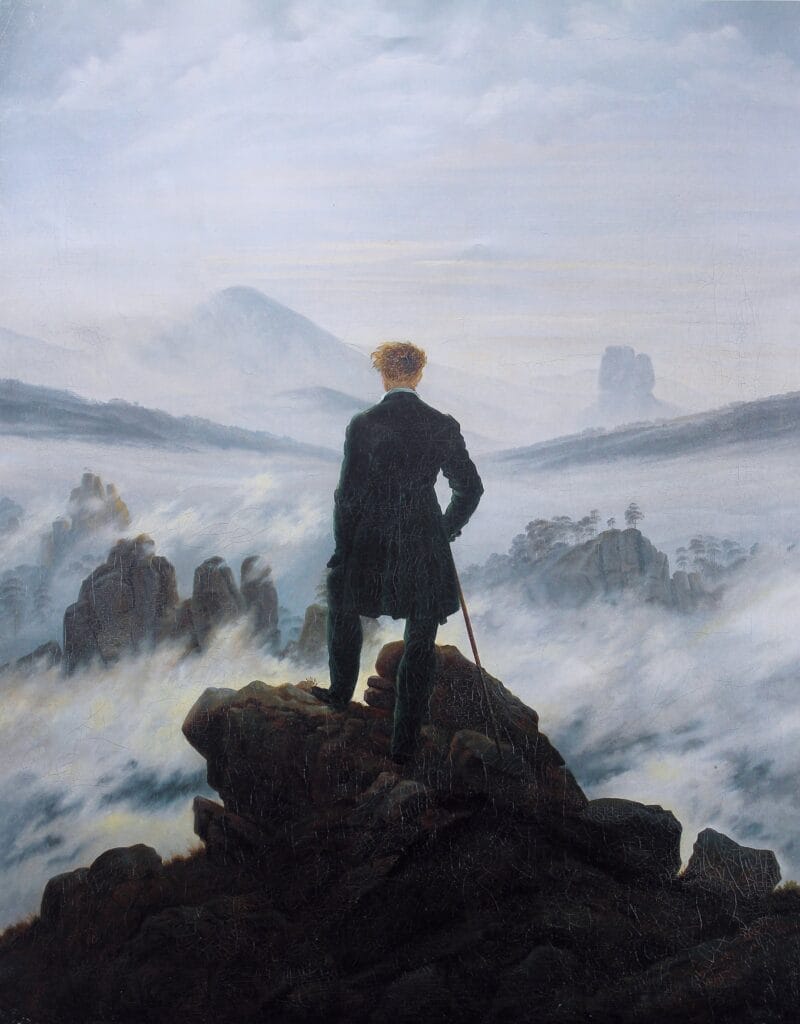
Which is why the essay’s most contemporary paragraph is a confession of failure. Even Thoreau — no phone, no inbox, all of Concord’s commerce barely a murmur beyond the trees — could not always leave the village behind:
But it sometimes happens that I cannot easily shake off the village. The thought of some work will run in my head and I am not where my body is — I am out of my senses. In my walks I would fain return to my senses. What business have I in the woods, if I am thinking of something out of the woods?
Anyone who has carried a workday into the trees knows this walk: the body among pines, the mind still at its desk. What is striking is the exactness of his phrase. To return to my senses is not, for Thoreau, a figure of speech. The senses are where attention actually lives — in soles and ears and skin — and the village’s claim on us is precisely a claim against them. The walk succeeds not when it arrives somewhere but when the walker arrives where his body already is.
Only then does the essay turn to its famous sentence — “in Wildness is the preservation of the World” — and by wildness Thoreau does not chiefly mean wilderness. He walks southwest, he tells us, toward whatever is unplanned, unclaimed, not yet domesticated; the wild is less a location than the portion of experience we did not arrange in advance. A meadow can hold it. So, on the right morning, can an alley. And the preservation he has in mind is not only the world’s but the walker’s: whatever in us remains capable of surprise is kept alive by regular traffic with what we cannot predict.
This is what the essay asks of a reader a century and a half on — not four hours, necessarily, and not a forest. It asks that some walk in the week be allowed to have no purpose it could fail to achieve, and that the senses, for that hour, be treated as the destination. Sauntering, so practiced, is less a way of covering ground than an art of attention — available, like most arts, at any door.
“Walking” is in the public domain and free to read in full at Project Gutenberg.